
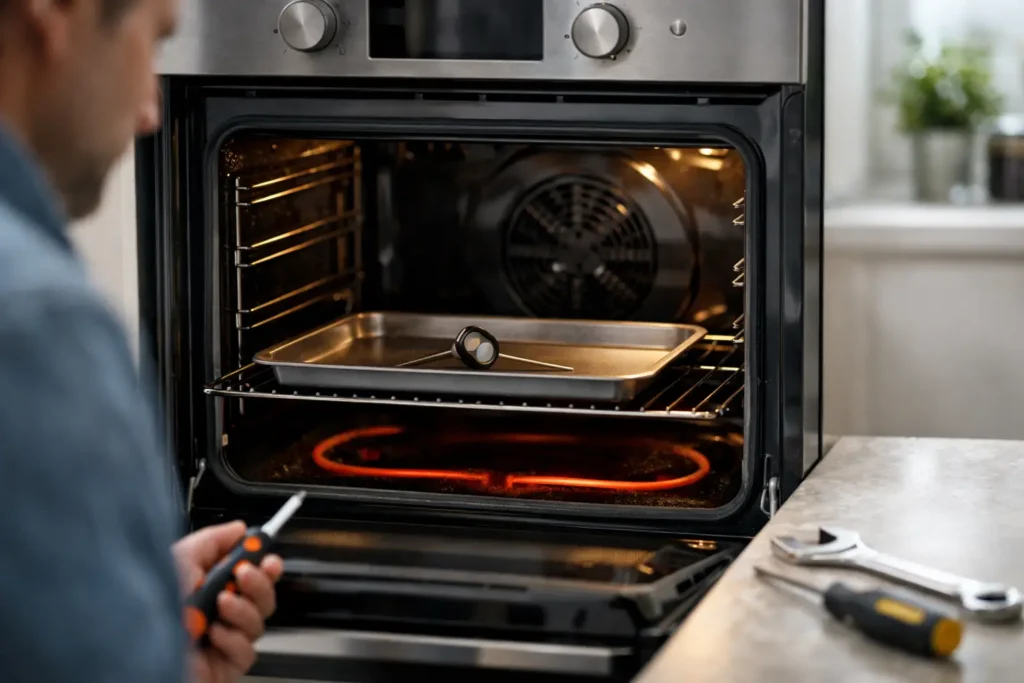
Dinner is already prepped, the oven is set to 350, and 20 minutes later the pan is still cold. An oven not heating is more than an inconvenience, especially when it is the appliance your household relies on every day. The cause may be as simple as an incorrect setting or a tripped breaker, but it can also involve a failed heating element, igniter, control, or wiring connection that needs professional diagnosis.
The useful question is not just why the oven is cold. It is whether the problem can be checked safely at home, whether the repair is worthwhile, and what information will help a technician find the fault without guessing.
Start With the Safe, Simple Checks
Before assuming a major part has failed, give the oven a few minutes to begin heating and confirm the basic settings. Many ovens take 10 to 15 minutes to preheat, and some models do not sound a preheat tone until the cavity reaches a specific temperature.
Check that the oven is set to Bake or Convection Bake rather than Broil, Keep Warm, Delay Start, Sabbath mode, or a timer setting. If the display is blank, check whether the clock needs to be set after a recent power outage. On some models, the oven will not operate normally until the time is programmed.
A few other safe checks can narrow down the issue:
- Confirm the range has power. Check the outlet, the home electrical panel, and the double-pole breaker that serves the appliance.
- Look at the cooktop. If electric surface burners work but the oven does not, the range may still have a partial power or oven-specific problem.
- Watch for error codes, flashing lights, or an unusual clicking sound, and write down what appears on the display.
- Inspect the visible bake element in an electric oven only after it has cooled. Blisters, cracks, burn marks, or a section that looks separated are strong signs of failure.
Do not remove panels, handle wiring, or keep resetting a breaker that trips again. If there is a burning smell, smoke, sparking, a damaged cord, or signs of melted wiring, turn the oven off at the breaker and arrange service. For a gas oven, leave the area and contact the gas utility or emergency services if you smell gas. Do not try to light the oven manually.
Why Is My Oven Not Heating?
The likely cause depends on whether you have an electric or gas oven, what functions still work, and whether the oven reaches some heat but never gets to the selected temperature. A proper diagnosis tests the appliance under the right conditions rather than replacing the most common part and hoping for the best.
Failed bake element in an electric oven
Most electric ovens use a bake element at the bottom of the oven cavity and a broil element at the top. During a standard bake cycle, the lower element does most of the work. When it fails, the oven may stay cold, heat very slowly, or only heat when broil is selected.
A broken element is sometimes visibly damaged, but not always. It can fail internally with no obvious crack. Testing it requires disconnecting power and checking the part and its circuit correctly. Replacing an element can be a practical repair when the range is otherwise in good condition and a compatible part is available.
Bad igniter in a gas oven
Gas ovens commonly use a glow-bar igniter. When you select Bake, the igniter should heat until it is hot enough to open the gas valve. A weak igniter may glow orange but still fail to draw enough electrical current to open that valve. This is why seeing a glowing igniter does not automatically mean it is working properly.
Typical symptoms include a gas oven that does not heat at all, takes a long time to ignite, or heats intermittently. Because gas ignition, valves, and electrical circuits work together, this repair is best left to an experienced appliance technician.
Control board, relay, or selector problem
Modern ovens use electronic control boards to send power to the bake element, broil element, convection fan, or igniter. Older models may use a mechanical thermostat or selector switch. If the control is not sending voltage when it should, the oven will not heat even though the heating component itself tests good.
Control issues can be more involved than a failed element. A technician needs to check incoming power, output voltage, wire connections, relays, and the heating circuit before recommending a board replacement. This matters because control boards can be expensive, and replacing one without confirming the fault is not honest or efficient.
Temperature sensor or thermostat issue
An oven that heats but runs too cool or too hot may have a temperature sensor, thermostat, or calibration issue. The oven may indicate that it is preheated while food remains undercooked, or it may overshoot the selected temperature and burn meals.
An inexpensive oven thermometer can help identify a pattern, but it is not always precise enough to diagnose the exact problem. A technician can compare the displayed temperature with actual cycling temperatures and determine whether calibration, a sensor replacement, or another repair is needed.
Power supply or wiring failure
Electric ranges normally require 240 volts for the oven heating circuits. A range can appear to have power because the display, light, or even some surface burners work, while one side of the 240-volt supply is missing. A tripped breaker, loose terminal connection, damaged power cord, or failed internal wire can cause this condition.
This is a common reason an oven not heating can be misleading. The appliance may look operational from the outside, but it cannot produce enough heat. Electrical testing inside a range should be done carefully with the proper equipment and safety procedures.
Symptoms That Help Identify the Problem
Small details make diagnosis faster. When scheduling service, note whether the oven is completely cold, only heats on Broil, takes much longer than usual to preheat, or loses heat during cooking. Mention whether the cooktop works, whether the display shows an error code, and whether the issue began after a power outage, self-clean cycle, move, or breaker trip.
The self-clean cycle deserves special mention. It creates extremely high temperatures, and while many ovens handle it without trouble, the heat can sometimes expose a weak thermal fuse, control board relay, or wiring connection. If the oven stopped working immediately after self-cleaning, tell the technician. That detail can point the diagnosis in the right direction.
A door that will not close fully can also contribute to poor oven performance. Heat escapes through a worn gasket or misaligned hinge, leading to longer cook times and uneven results. It is less likely to cause a completely cold oven, but it is worth addressing when it affects temperature consistency.
When Repair Makes Sense
Many heating problems are repairable, and a targeted repair usually costs less than replacing a full range. A failed bake element, igniter, sensor, or damaged connection often has a straightforward solution. The decision becomes less clear when an older appliance needs a costly control board, has multiple failures, or has parts that are discontinued.
That does not mean replacement is automatically the right answer. Appliance age, overall condition, part availability, repair cost, and how well the range has served your household all matter. A clear diagnosis should give you enough information to decide without pressure.
For homeowners, landlords, and property managers in Winnipeg, Steinbach, Blumenort, and nearby Manitoba communities, TrueFixPro can inspect the heating system, explain the findings in plain language, and discuss compatible replacement part options when a repair is practical.
Avoid These Common Mistakes
Do not keep running a failing oven for long periods to see if it eventually catches up. A weak igniter, damaged element, or loose electrical connection can become less reliable and may cause additional damage. Avoid using extension cords for a range or attempting to bypass a thermal fuse, door switch, or safety component.
It is also wise not to order a part based only on a symptom or a photo. Several parts can create the same complaint. For example, an electric oven with no heat may have a bad element, a failed relay, missing supply voltage, or a wiring issue. Accurate testing protects you from paying for the wrong part.
If your oven is cold when you need it most, use the simple checks, make the appliance safe, and take note of the symptoms. A careful diagnosis can turn a frustrating kitchen interruption into a clear repair decision and get you back to cooking with confidence.